Article body
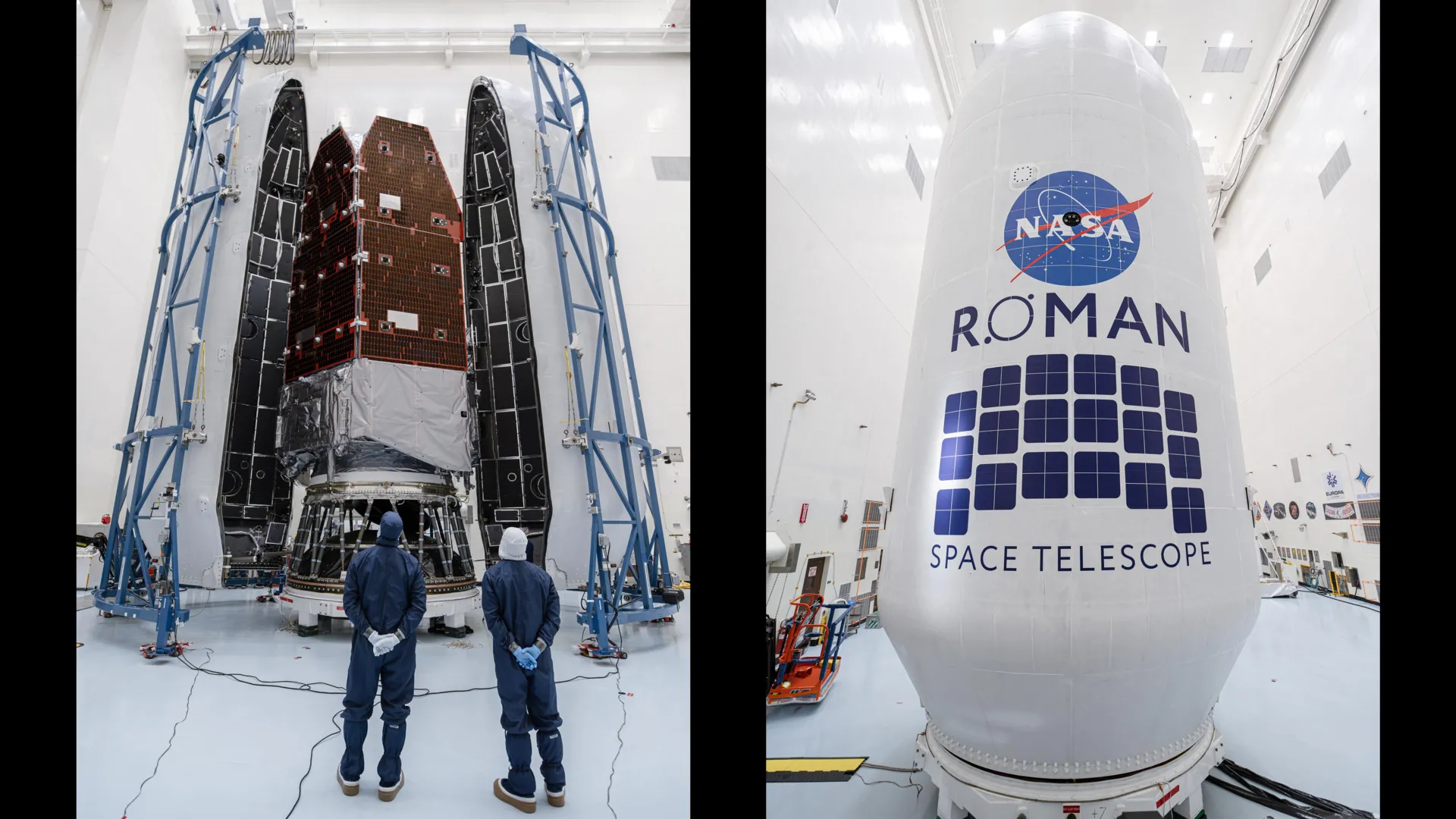
NASA's Roman Space Telescope is now one major step closer to liftoff. On August 21, teams enclosed the observatory inside the protective fairing of its SpaceX Falcon Heavy rocket at the Payload Hazardous Servicing Facility at NASA's Kennedy Space Center in Florida. The fairing is the large shell that surrounds a spacecraft at the top of a rocket. Standing 43 feet tall, it protects Roman while the observatory is on the ground and during the most violent early stages of launch.
As Falcon Heavy accelerates through Earth's atmosphere, Roman will experience powerful sound waves, aerodynamic pressure, and significant heating. The fairing is designed to shield the observatory from those stresses. Once the rocket climbs high enough that the surrounding atmosphere is no longer a threat, the fairing will no longer be needed. A few minutes after liftoff, its two halves will separate and fall away, allowing Roman to continue its journey into space.
Roman will ultimately travel toward Sun-Earth Lagrange point 2 (L2), a location in space where the gravitational influence of the Sun and Earth helps spacecraft maintain a relatively stable position. This region is especially useful for powerful space observatories because it provides a favorable environment for continuously observing the universe. Once Roman begins science operations, researchers expect it to discover thousands of exoplanets, which are planets orbiting stars beyond our solar system. Studying such a large population could help astronomers determine how common different types of planetary systems are and whether some distant worlds resemble planets closer to home.